No Cell Service? No Problem!
My Weekend with the Ottawa Auxiliary Communication Service (ACS)
Most people spend their Saturday mornings sleeping in or grabbing brunch. Last weekend, I spent mine pretending a tornado had just wiped out the communications infrastructure in nearby West Carleton.
Don't worry, it was only a drill! 🌪️
I hold my ham radio license and have training on ARES (Amateur Radio Emergency Service), and Auxiliary Communication Service (ACS). The goal? To be ready to step in when standard communication lines (like cell towers and internet) go down during a disaster. And knit together different organizations providing disaster relief - police departments, fire departments, hospitals, disaster response centres, municipalities, provincial government, federal government, military, and any non-government organizations like the Red Cross, for example.
These exercises, where we put our training into practice, are where the rubber meets the road.
Special thanks to the Ottawa Amateur Radio Club, the Ottawa Valley Mobile Radio Club, West Carleton Disaster Relief, and especially Josh Siu (VE3EAM) who crafted this exercise.
The Mission: West Carleton Relief
The scenario was serious: A hypothetical tornado had swept through the area, damaging buildings and disrupting comms. First responders set up a command post, and they needed us to verify evacuation routes from Kanata to the Kinburn Client Centre.
My role was Driver and Joint Radio Operator for Vehicle 1. I loaded up my car, fired up my Yaesu FTM 500 DR radio, other equipment, and joined my team (Roger and Will) to head out into the "disaster zone."
The Drive: Scenery and Signals
We couldn't have asked for a nicer backdrop for a disaster simulation. The weather was mild with very light snow falling, and it was incredibly pretty driving through the farms and forests along the Ottawa River.
But we weren't just sightseeing. We were testing radio coverage in the region, in addition to the exercise training and practice.
Every few kilometres, we had to report our location and signal strength to "Net Control" (the command centre). There is something undeniably cool about pushing a button on a microphone and talking to someone miles away, purely through radio waves, with absolutely no reliance on the internet or a phone plan. In a disaster, it saves lives and property!
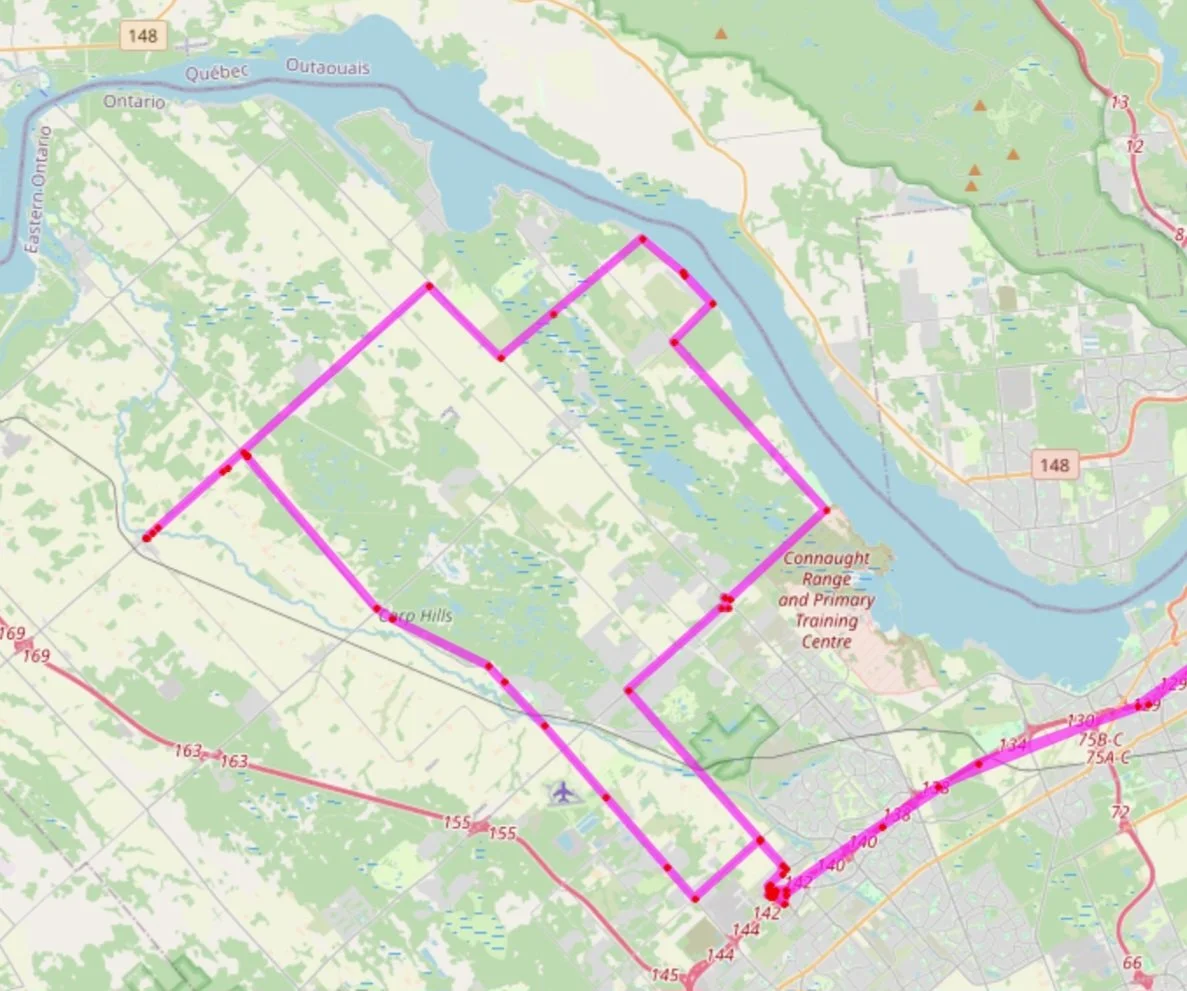
A map of APRS beacon points my radio made automatically during the excercise
This is a map of my APRS beaconing. It’s like sharing your location in Google Maps, only powered entirely by radio frequencies. Friends and Net Control could track my vehicle’s exact movement on a map in real-time, even if the cellular network was completely dead. The nerd factor here is high, but the safety utility is even higher.
Real Talk: Challenges Happen
I always try to be transparent in these reports—things rarely go perfectly according to the script, and that’s exactly why we practice.
The Glitch: We actually had some minor trouble with the primary repeater we were supposed to use. It was a bit spotty at first. In a real emergency, you can’t just call IT support. Having a plan to adapt, switch frequencies, and figure it out on the fly helps. It added a layer of realism that you just can't get in a classroom.
The Learning Curve: We had a group of people with very mixed experience levels. Ham radio has a very specific "script" (protocol) for emergency traffic to ensure messages are concise and clear. For some participants, doing this along with other tasks was naturally overwhelming.
It was a good reminder that while the tech is fun, the training is what makes things less cognitively overloading, more automatic, and saves lives. Keeping communications short, calm, and standard takes practice.
The "Why"
By the time we reached the Kinburn Client Centre to set up the evacuation hub, I was reminded why I put the time into this hobby.
When the power is out, people’s homes flooded or destroyed, and the cell towers are silent, being able to coordinate help, verify safe routes, and adapt to the situation in real time isn't just a hobby. It’s a lifeline.
It was a great morning of learning, adapting, and serving the community with the West Carleton Disaster Relief team, both regional Amateur Radio Clubs, and the Ottawa ACS team. Plus, it is fun.
73! ∿